
A healthy smile isn’t just about looks—it affects chewing, speaking, and overall oral health. At Capogna Orthodontics, we treat common orthodontic problems using solutions that work for each patient. Many treatments include the use of permanent retainers, fixed retainers, or metal retainers to keep results long-lasting.
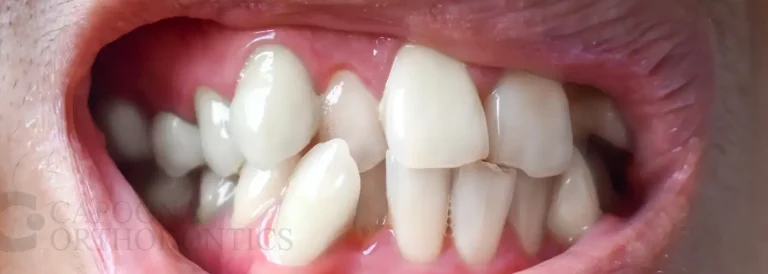
Crowded or Overlapping Teeth
Crowded teeth occur when the jaw doesn’t have enough space for all teeth. This can make cleaning difficult and increase the risk of decay.
Treatment options:
- Braces or clear aligners to straighten teeth
- A bonded retainer placed behind teeth to maintain alignment
- Regular follow-ups to monitor any movement
Upper Teeth Overlap (Overbite)
An overbite happens when upper teeth cover too much of the lower teeth. It can cause jaw pain or tooth wear.
- Treatment options:
- Braces with elastics for bite correction
- Invisalign for mild cases
- Wire retainers or permanent retainers after treatment
Lower Teeth Protrusion (Underbite)
Underbites occur when lower teeth stick out past the upper teeth. This can make chewing or speaking difficult.
Treatment options:
- Braces or clear aligners
- Jaw surgery for severe cases
- Fixed retainer to hold teeth in position
Teeth That Bite Inside (Crossbite)
A crossbite is when some upper teeth bite inside the lower teeth. This can lead to uneven tooth wear and jaw issues.
Treatment options:
- Palatal expanders to widen the jaw
- Braces to correct tooth alignment
- Permanent retainer to maintain results
Open Space Between Upper and Lower Teeth (Open Bite)
Open bites happen when upper and lower teeth don’t touch when the mouth is closed.
Treatment options:
- Braces or aligners to guide teeth together
- Surgical treatment for severe cases
- Metal retainer or bonded retainer for long-term stability
Gaps or Spaces Between Teeth
Gaps can develop due to missing teeth or jaw size mismatch.
Treatment options:
- Braces or clear aligners to close gaps
- Wire retainer to maintain alignment
- Monitoring to prevent new gaps from forming
Front Teeth Not Centered (Midline Misalignment)
When upper and lower front teeth don’t line up, it affects smile symmetry.
Treatment options:
- Braces or Invisalign to adjust alignment
- Permanent retainers to keep teeth in place
Teeth That Don’t Erupt Properly (Impacted Teeth)
Impacted teeth, often canines or wisdom teeth, don’t grow correctly.
Treatment options:
- Minor cases guided with braces
- Surgical exposure for severe cases
- Fixed retainer afterward to hold teeth in proper position
Rotated or Twisted Teeth
Twisted teeth can create gaps or crowding, affecting bite and appearance.
Treatment options:
- Braces or clear aligners to rotate teeth
- Permanent retainers or metal retainers for stability
Teeth Shifting After Braces (Relapse)
Even after orthodontic treatment, teeth can move back if retainers aren’t worn.
Treatment options:
- Use permanent retainers as recommended
- Replace a permanent retainer if it breaks
- Know permanent retainer cost and plan for upkeep
FAQs
1. What is a permanent retainer?
A permanent retainer is a wire bonded to the back of teeth to keep them straight long-term.
2. How long should a fixed retainer stay in place?
Fixed retainers are usually worn for several years. Regular check-ups help ensure effectiveness.
3. What should I do if my permanent retainer broke?
Contact your orthodontist immediately for retainer replacement to prevent teeth from shifting.
4. Are metal retainers uncomfortable?
Metal retainers may feel tight at first but become comfortable as teeth adjust.
5. How much does a permanent retainer cost?
Permanent retainer cost varies depending on type and Orthodontics clinic. Capogna Orthodontics provides exact estimates during consultation.